
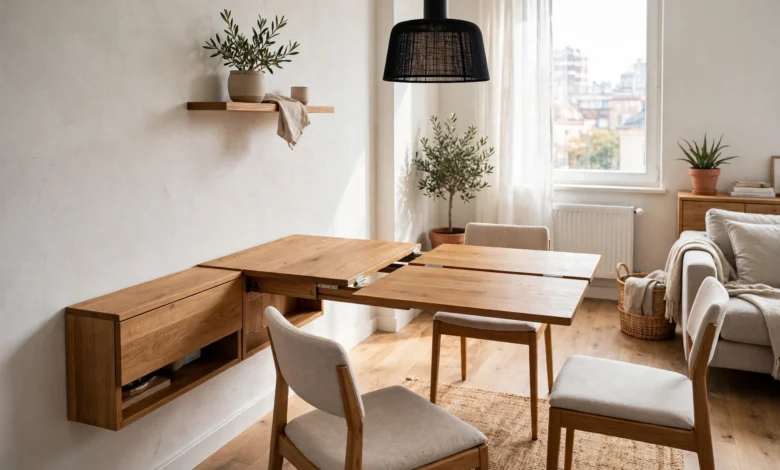
A transformer table solves the small-space dining problem by living at two sizes: closed, it works as a slim console or compact everyday table; open, the same transformer table stretches to seat a full dinner party. If your dining area doubles as an office, hallway or playroom, it gives you a big table only on the days you actually need one.
The term now draws about 74,000 searches a month, up 61% year over year according to Rising Trends data from October 2026 — because more homes ask every room to do two or three jobs at once. This guide teaches you how the mechanisms work, how to measure your space, what to test before you buy, and the mistakes that make owners regret the purchase.
Key takeaways
- A transformer table stores its extra tabletop inside itself or alongside it, so you choose the size per occasion instead of per room.
- Butterfly leaves are the most convenient mechanism, telescopic rails are the simplest and strongest, and console transformers save the most space.
- Allow roughly 60 cm of table edge per diner, and test knee room at both the closed and extended sizes.
- Judge the mechanism, not the finish: open and close the table repeatedly and check for wobble at full extension.
- Decide where loose leaves will live before you buy — not on delivery day.
How does a transformer table work?
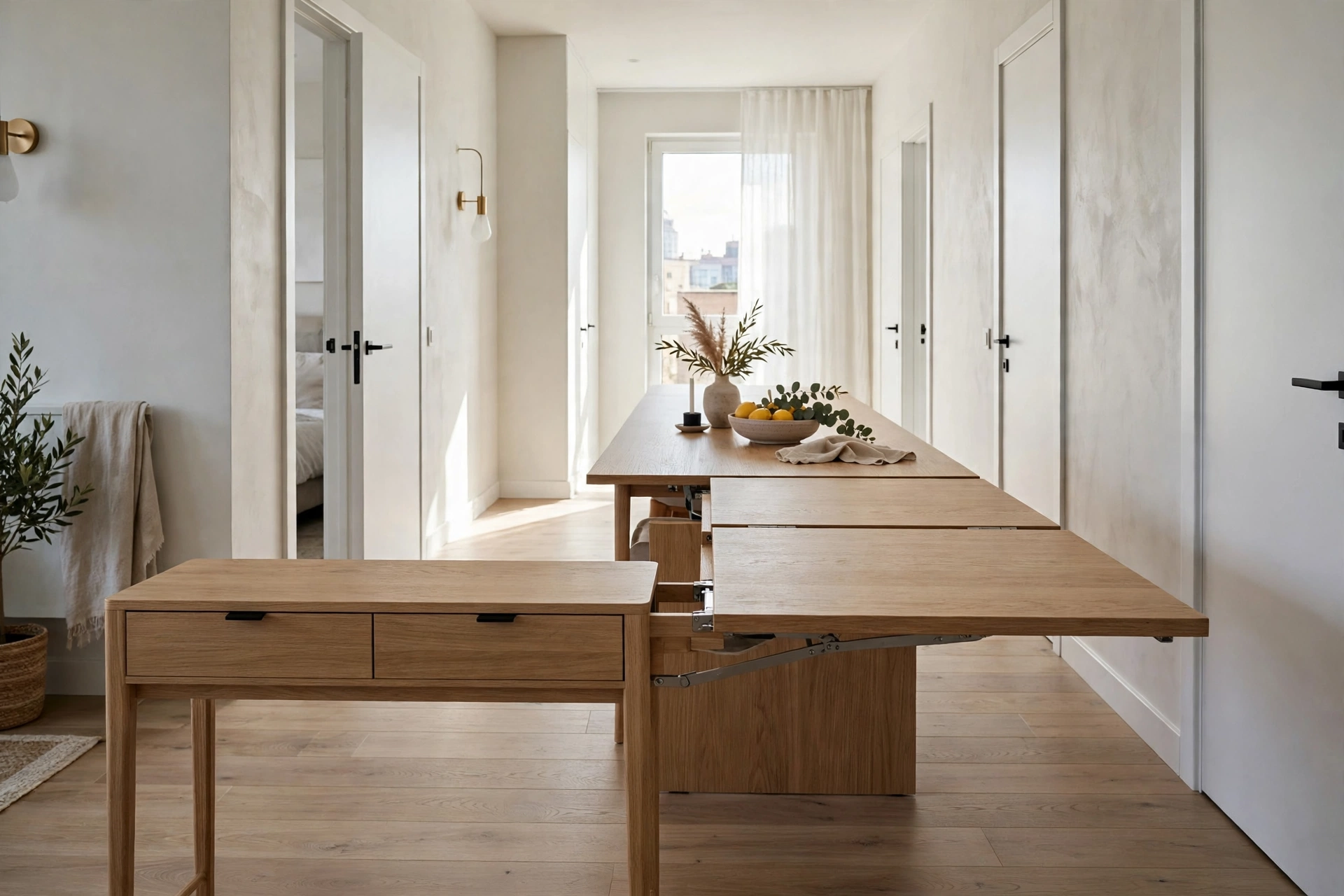
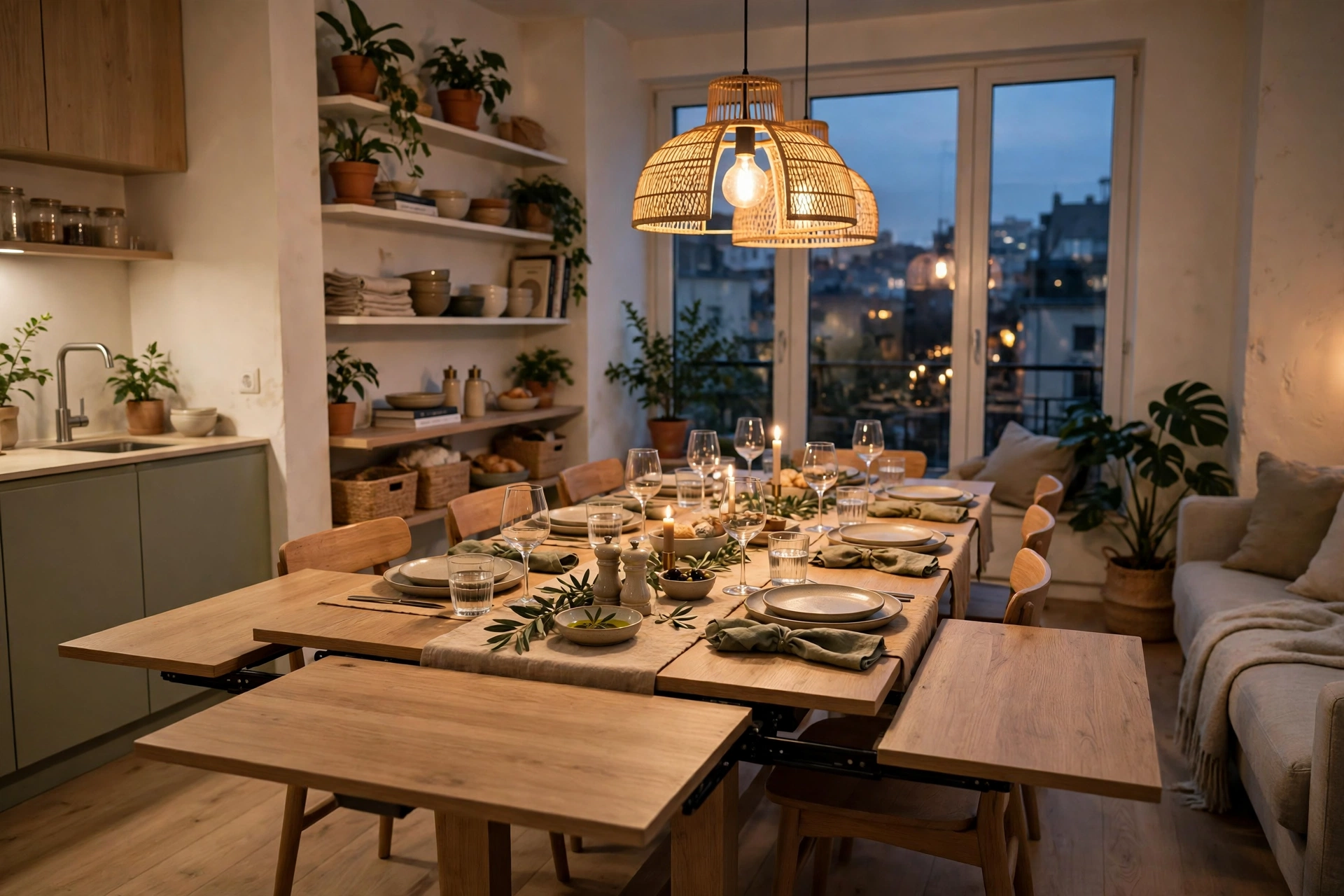
A transformer table works by hiding extra tabletop sections — called leaves — inside or under a frame that slides apart. You pull the two halves of the top open, the frame extends on rails, and the leaves fold out or drop in to fill the gap. Close it by reversing the steps, and the leaves disappear again. Every design below is just a different answer to one question: where does the extra tabletop live when you do not need it?
Butterfly leaves
The butterfly leaf is the most elegant solution. The extension leaves are hinged underneath the tabletop and fold out like wings when you pull the two halves of the top apart.
Because the leaves store inside the table itself, there is nothing to carry from a closet and nowhere to lose them. The trade-off is mechanical complexity: the folding hinges and the sliding frame carry the full load of the opened table, so build quality matters more here than in simpler designs. A well-made butterfly table opens in under a minute with one person; a cheap one wobbles, pinches, and develops gaps along the seam lines within a year.
Telescopic rails and stored leaves
The classic extending table uses telescopic rails — two or more sliding metal or hardwood runners under the top that pull apart smoothly and lock at set lengths. The extension leaves on these tables are often separate boards that drop into the gap.
Some leaves store flat under the top; others live in a cupboard. This design is mechanically simple and very strong, which is why it dominates traditional dining furniture. The downside is handling: loose leaves are heavy, awkward to store, and easy to scratch. If the leaves store under the tabletop, check that the storage frame does not steal knee room when the table is closed.
Console-to-dining transformers
The most dramatic category starts life as a console table roughly 40–50 cm deep and extends in stages — sometimes through four or five leaf positions — into a full dining table. These rely on long aluminium telescopic rails that span the whole extended length, with leaves that stack or store separately.
They are brilliant for homes where a dining table simply cannot exist most of the time. The catch is that at full extension, the table’s stability depends entirely on the rail system, and the leaves must be handled and stored with care.
Transformer table mechanisms compared
Use this table to match a mechanism to your home before you fall for a finish. The right choice depends on how often you extend the table and how much storage you can honestly spare.
| Mechanism | Where the leaves live | Opening effort | Best for | Watch out for |
|---|---|---|---|---|
| Butterfly leaf | Hinged under the tabletop, self-storing | One person, under a minute | Everyday flexibility with nothing to store | Hinge and frame quality; seams can gap on cheap models |
| Telescopic rails, separate leaves | Flat under the top or in a cupboard | One or two people, a few minutes | Strength and traditional dining rooms | Loose leaves are heavy, awkward and easy to scratch |
| Console-to-dining | Stacked or stored separately | One person, in stages | Studios and rooms with no permanent dining space | Stability at full extension depends entirely on the rails |
Before you buy: measure your room and count your diners
Specifications pages love the extended length, but your daily life happens at the closed length and in the mechanics between the two. Do the measuring work first and the shopping becomes simple.
What you need before you start
- A tape measure and some painter’s tape for marking footprints on the floor.
- Your honest numbers: how many people eat here daily, and the largest group you realistically host.
- The chairs you actually own, since chair width decides how many fit along each side.
- A candidate home for loose leaves, if you are considering a telescopic design.
How to measure for a transformer table
- Measure the wall or floor area where the closed table will live, and note the depth available — a console transformer needs only 40–50 cm.
- Mark the fully extended footprint on the floor with painter’s tape, using the manufacturer’s extended dimensions.
- Place your chairs around the taped outline and sit in them, checking that you can still walk behind a seated diner.
- Divide the usable table edge by roughly 60 cm per person to get an honest seat count at both sizes.
- Measure the cupboard or corner where loose leaves would be stored, and compare it with the leaf dimensions.
- Check the doorways, hallways and turns the table — or its delivery box — must pass through to reach the room.
If you want to test both sizes against your room before committing, model the layout in 3D first. Our guide to prototyping and 3D design tools explains how a quick digital mock-up prevents expensive sizing mistakes.
What to check before you buy a transformer table
Check these five points in person whenever you can. Together they predict how the table will feel in year five, not just on delivery day.
- Seating capacity, both ways. Count chairs at the closed size and at full extension. Allow roughly 60 cm of table edge per person for comfortable dining, and check whether legs or the rail frame block the end seats when extended — many tables technically seat eight but only six can get their knees in.
- Mechanism durability. Open and close the table three or four times in the shop. It should move with even resistance, lock without play, and sit flat at every stage. Side-to-side wobble when extended is the single best predictor of a table you will hate in two years. Rail hardware quality matters as much here as it does in the metal furniture brands known for lasting construction.
- Leg room and apron height. Sit down. Your thighs should clear the apron (the frame under the top) with room to cross your legs, and the rail hardware should not hang where knees naturally go.
- Leaf storage. Self-storing leaves are convenient but add weight and mechanism cost. Separate leaves need a home — measure them against your cupboard before assuming they will fit.
- Surface continuity. Run a hand across the closed seams. On a good table, the grain matches and the joins are nearly invisible; on a poor one, every seam catches the light and crumbs. Retailers such as IKEA built much of their dining range around extending designs, which makes their showrooms a useful place to practise these checks across several mechanisms in one visit.
Who benefits most from a transformer table?
Anyone whose dining space has a second job benefits most. In a studio or one-bedroom flat, a console transformer lets the same square metres serve as entryway, desk, and dining room across a single day. In a family home, an extending table handles Tuesday homework and a ten-person holiday dinner with equal ease.
Multi-use rooms — the spare room that is also an office, the open-plan kitchen that is also a playroom — are where these tables earn their price, because the alternative is either a table that is always too big or one that fails the moment guests arrive.
They also pair naturally with flexible seating. If you are exploring how adaptable furniture shapes a room’s whole style, the examples in these trending interior styles show how multi-functional pieces anchor several of the looks people are copying right now. A transformer table plus stackable chairs or a storage bench is the practical core of most of those schemes. Planning the combination on paper first — or in a browser-based room planner such as Sketch3D-Art Studio Pro — shows you whether the extended table and the extra chairs truly coexist in your floor plan.
Common mistakes
- Buying for the extended size only. You will live with the closed table every day; if it overwhelms the room at console size, the clever mechanism will not save it.
- Counting seats by edge length alone. Legs, aprons and rail frames block real knees. A table that “seats eight” on paper may seat six in practice.
- Never opening the table in the shop. Wobble, play in the locks and uneven seams only appear when the table is fully extended — exactly the state most showrooms avoid displaying.
- Forgetting leaf storage until delivery day. Loose leaves are large, heavy boards. If they have no measured home, they will live against a wall and get damaged.
- Choosing the finish over the mechanism. A transformer table is a machine you will operate hundreds of times. Pretty veneer on weak rails is the most expensive combination of all.
Frequently asked questions
How much table space does each person need?
Allow roughly 60 cm of table edge per diner for comfortable eating with elbows and serving dishes. Measure the usable edge, not the full length, and subtract anywhere legs or rails block knees.
How deep is a console transformer table when closed?
Most console transformers are about 40–50 cm deep when closed, similar to a hallway console. They then extend in stages — sometimes through four or five leaf positions — up to full dining length.
Can one person open a transformer table alone?
Yes, for most designs. A well-made butterfly table opens in under a minute with one person, and console models extend in stages single-handed. Large telescopic tables with heavy separate leaves are easier with two people.
Are transformer tables sturdy enough for daily use?
A good one is, because the rails and locks carry the load. Test it fully extended: the top should sit flat, lock without play, and resist side-to-side wobble. If it wobbles in the shop, it will only get worse at home.
Where do I store the leaves of an extending table?
Self-storing designs keep leaves hinged or racked under the tabletop, which is convenient but adds weight. Separate leaves need a cupboard or flat storage spot, so measure both the leaves and the space before you buy.
Conclusion
Buy the mechanism first and the look second. A transformer table is a machine you will operate hundreds of times, and the difference between a good one and a bad one is not the finish — it is whether the rails still glide and the top still sits flat in year five. Prioritise smooth, wobble-free extension, honest seating counts at both sizes, and leaf storage that fits your actual home. Your next step is simple: tape the extended footprint on your floor this week and live with the outline for a day before you order anything.
Do you host often in a small space — and if so, would you rather store loose leaves or pay more for a self-storing butterfly design?


 English
 العربية
 Français