

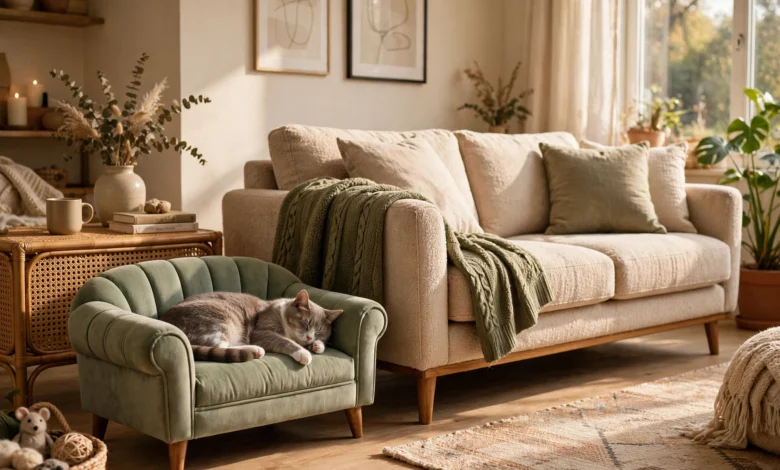
A cat sofa only earns its floor space if your cat actually uses it, and cats vote with their behaviour: they scratch what is rough and vertical, perch where they can survey the room, and hide where it is dark, warm and enclosed. The search data says owners are ready to furnish for that behaviour — “cat sofa” draws roughly 12,100 searches a month, up 52% year on year (Rising Trends, October 2026), and Homestyler’s design signals flag pet spaces as an emerging niche. This guide teaches you to choose and arrange pet-friendly furniture from the cat’s point of view, so the piece you buy becomes the cat’s favourite spot instead of an expensive ornament.
Key takeaways
- Design from behaviour first: every cat needs somewhere to scratch, somewhere high to perch and somewhere enclosed to hide.
- Place the cat sofa where the cat already likes to be — near your seating and a window — not in an empty corner you prefer.
- Choose durable, tightly woven, washable fabrics; loose weaves snag claws and trap hair and odours.
- Integrated pet furniture saves space in small homes; standalone pieces are easier to replace, move and wash.
- Introduce the piece gradually with familiar scents and treats; cats reject furniture that arrives smelling of a warehouse.
Start with feline behaviour, not furniture catalogues
Cats are not small dogs, and they are definitely not small humans. Three behaviours drive almost every furniture decision. Scratching maintains claws and marks territory, so it will happen on something — your only choice is whether that something is designed for it. Perching satisfies the instinct to survey from height and safety. Hiding lets the cat regulate stimulation; a cat with a good hiding spot is a calmer cat everywhere else.
What does each behaviour require from a piece of furniture?
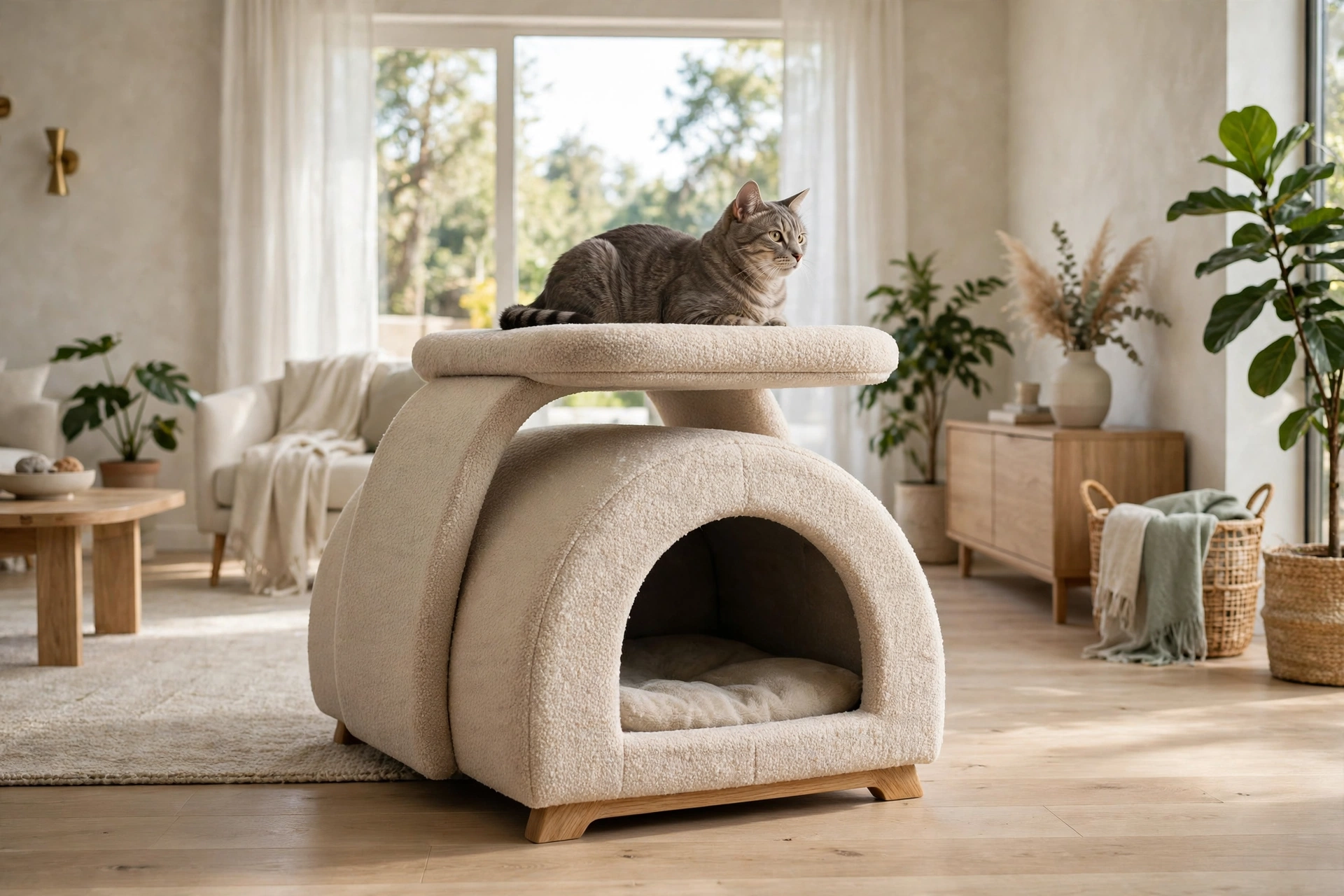
Scratching requires a stable, resistant surface tall or long enough for a full stretch. Perching requires a raised, stable platform with a view of the room’s activity. Hiding requires an enclosed or covered space with one entrance the cat controls. A cat sofa that offers a cushioned perch plus a covered nook underneath satisfies two behaviours in one footprint — which is exactly why the format is trending while purely decorative pet beds gather dust.

Watch your own cat for a week before you buy. Note where it sleeps at noon, where it scratches after waking, and which high point it claims. Those three observations are your design brief, and they are more valuable than any product description. Cats are individuals: the bold cat wants the highest perch in the busiest room, while the shy cat wants the nook near your chair but facing a wall.
Choosing the cat sofa: a step-by-step check
Work through these checks in order, in the shop or on the product page, and reject any piece that fails the first three — comfort features cannot compensate for instability or unusable surfaces.
- Push the piece firmly from the side; it must not rock, slide or tip when a cat lands on it at speed.
- Measure the perch or seat against your cat stretched out; it should fit the cat’s full length with room to turn.
- Run your fingernail across the fabric; if threads lift or snag, claws will shred it within months.
- Check that covers unzip or that cushions detach for washing, and confirm replacements exist.
- Inspect the base and legs for a scratchable surface or a replaceable scratch panel.
- Smell the piece; strong chemical odours mean airing it out for days before the cat will approach.
Size is the check buyers most often flub, because cats in product photos are frequently kittens or small breeds. Measure your cat nose-to-tail-base while it sleeps stretched, then add a margin. A perch that fits “most cats” fits your large cat poorly, and a cat that cannot stretch out will simply sleep on your sofa instead — which defeats the entire purchase.
Fabric and construction: what survives claws
Fabric choice decides whether pet-friendly furniture looks good in year three or only in month one. Tightly woven fabrics — microfibre, dense canvas, quality outdoor weaves — resist claw penetration because there is no loose loop to hook. Velvet-style short piles hide scratches surprisingly well and release hair with a damp glove. Loose linen-look weaves, bouclé loops and wicker invite picking and unravel fast.
Which fabrics handle hair and washing best?
Fabrics handle hair best when the pile is short and the weave is tight, so hair sits on the surface where a lint roller or vacuum lifts it instead of working into the structure. For washing, removable covers with zips beat spot-clean-only upholstery every time, because accidents, hairballs and muddy paws are certainties, not risks. If the main sofa is not washable, protect it with a washable throw in the cat’s favourite spot and launder that instead.
| Fabric | Claw resistance | Hair behaviour | Washability |
|---|---|---|---|
| Microfibre (tight weave) | High | Hair sits on surface, vacuums off | Usually removable covers |
| Dense canvas | High | Moderate; brush or vacuum | Often machine washable |
| Short-pile velvet style | Medium–high | Hides hair between cleans | Spot clean or covers |
| Outdoor performance weave | High | Low cling, hoses down | Excellent |
| Loose linen-look weave | Low — snags | Traps hair in weave | Varies |
| Bouclé / looped wool | Low — loops pull | Traps hair deeply | Difficult |
Construction matters as much as cloth. Look for a frame that does not flex when you press the arms, cushions with enough density to support a cat landing from height, and scratch surfaces that are replaceable panels rather than structural parts. A replaceable scratch panel turns the most damaged component into a consumable — the same logic that makes modular human furniture last, applied at cat scale.
Integrated or standalone pet furniture?
Integrated designs build the cat’s territory into human furniture: a side table with a hideaway cube beneath, a bookshelf with a perch level, a window seat with a scratching side panel. Standalone pieces — cat sofas, trees and beds — dedicate their whole footprint to the cat. Neither is universally better; the right answer depends on your space and your cat’s habits.
When does integrated furniture win?
Integrated furniture wins in small homes where every square metre is contested, because the cat’s nook consumes space the side table already occupied. It also wins aesthetically, since one designed object replaces two mismatched ones. Standalone wins when your cat is fussy, elderly or likely to outgrow the piece, because you can move, replace or donate it without touching your main furniture.
Consider hygiene in the decision too. A standalone cat sofa can go to the laundromat-scale wash or out to the balcony for a deep clean; an integrated hideaway must be vacuumed and wiped in place. Many households run a hybrid: integrated perch near the window where the cat supervises the street, standalone washable bed near the humans for evening. The styling examples in our collection of interior design examples and trending styles show how deliberately designed pet pieces hold their own in serious rooms.
Placement and introduction: making the cat actually use it
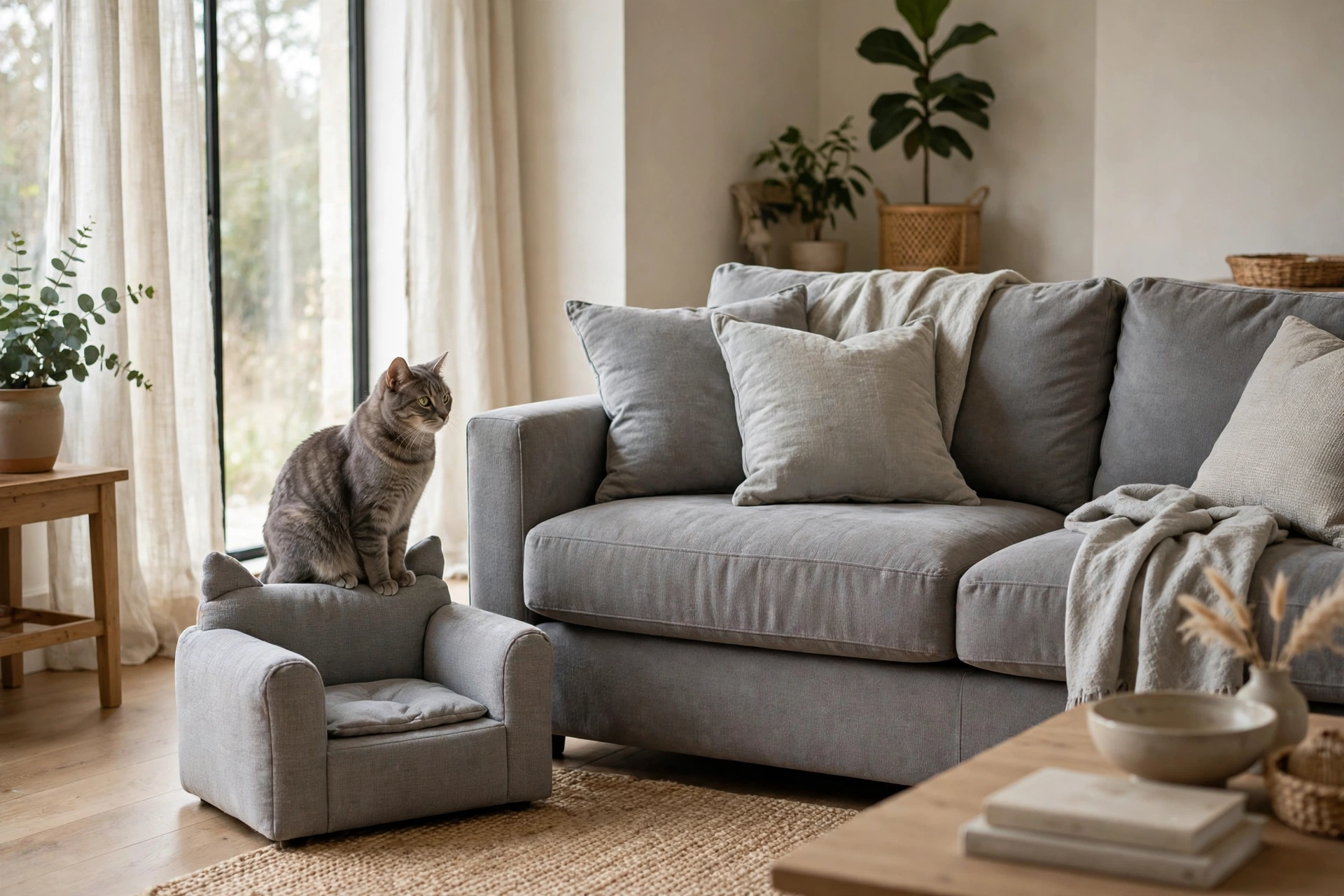
The best cat sofa fails in the wrong place. Cats choose spots by warmth, vantage and proximity to their people, in roughly that order. Place the piece beside your own sofa or reading chair, within sight of a window if possible, and out of draughts and noisy appliances. A quiet, calm zone helps too — the same principles that make Japanese zen garden spaces so restful indoors apply to where a cat will choose to unwind.
- Position the piece where the cat already naps, or immediately beside that spot.
- Rub a cloth on the cat’s cheeks and wipe it on the new furniture to transfer familiar scent.
- Place a worn item of your clothing or the cat’s old blanket on it for the first days.
- Feed treats and play sessions on and around the piece, never forcing the cat onto it.
- Move the old favourite gradually — a metre a day — if you are transitioning spots.
Give it two weeks before judging. Cats investigate new objects on their own schedule, and the piece you despair of on day three is often claimed on day nine. If the cat uses your sofa instead, put the cat sofa in that exact footprint’s neighbourhood and make your sofa briefly less appealing with a throw you remove when you sit down. You are negotiating, and patience is your leverage.
Common mistakes
The most common mistake is buying for the photograph: a sculptural cat sofa in an impractical fabric, placed in a spare room the cat never enters. The second is ignoring washability until the first hairball. The third is choosing kitten scale for an adult cat — re-measure rather than trusting “suitable for most cats.”
Owners also forget the scratching plan. A cat sofa without a legitimate scratch surface nearby simply relocates scratching to your sofa’s arm. Place a scratcher beside the new piece from day one. And avoid scented sprays and new-furniture smells during introduction; to a cat, your home’s familiar smell is the safety signal, which is why even outdoor features like the ponds in our modern water fountain collection need pet-safe placement thinking. Retailers such as IKEA now stock pet ranges designed around these same behaviours — study their dimensions and materials even if you buy elsewhere.
Frequently asked questions
Why does my cat ignore the new cat sofa?
Usually because of placement or smell, not the sofa itself. Move it to where the cat already sleeps, transfer the cat’s scent onto it with a cloth, and add treats and play around it. Judge the experiment after two weeks, not two days.
What size cat sofa should I buy?
Measure your cat fully stretched while sleeping, then choose a perch or bed at least that long with room to turn. Ignore “one size fits most” claims, which are photographed on kittens. Large breeds need the largest size in almost every range.
Which fabric is best for homes with cats?
Tightly woven microfibre, dense canvas and performance outdoor weaves resist claws and release hair most easily. Short-pile velvet styles are a good decorative compromise. Avoid loose weaves and looped bouclé, which snag, pull and trap hair.
Is integrated pet furniture worth it?
It is worth it in small homes where floor space is precious, because the cat’s territory hides inside furniture you already own. Choose standalone pieces if your cat is elderly, fussy or likely to need the piece moved or replaced. Many homes do best with one of each.
How do I stop my cat scratching my own sofa instead?
Give the cat a better option in the right place: a stable scratcher beside the sofa it currently uses, at full-stretch height, introduced with play. Protect your sofa temporarily with a throw while the habit transfers. Punishment does not work; a superior alternative does.
Conclusion
Pet-friendly furniture succeeds when it is designed around behaviour: a scratchable surface, a high perch, a dark hideaway, washable tight-weave fabric, and a place beside you in the room’s life. Audit any cat sofa against those five tests before you buy, then introduce it patiently with scent and treats. Your next step is the week of observation — note where your cat scratches, perches and hides, and let that map choose the piece. Where does your cat claim its favourite spot today, and what does that tell you?




 English
 العربية
 Français