


A boneless couch is a low, legless sofa built entirely from foam — no wooden frame, no metal structure — usually sold as modular pieces you arrange to fit your room. It has become the single most-searched interiors topic tracked by Rising Trends, drawing about 301,000 searches a month and sitting 37% higher than a year ago (October 2026 data). That makes it the biggest interiors search of the moment. This guide explains what it is, who it genuinely suits, and exactly what to check before the trend talks you into buying one.
Key takeaways
- A boneless couch has no frame or legs: the seat, back and arms are shaped blocks of high-density foam, usually modular and vacuum-packed for shipping.
- It draws about 301,000 searches a month, up 37% year over year — the biggest interiors search tracked by Rising Trends.
- Its real strengths are flexibility, renter-friendly delivery, soft safety for kids and pets, and washable covers on many models.
- Its real weaknesses are foam-dependent support, a very low seat height, and a relaxed silhouette that never looks tailored.
- Buy on foam density, washable covers, module dimensions and the return window — not on how it looks in a styled photo.
What is a boneless couch, exactly?
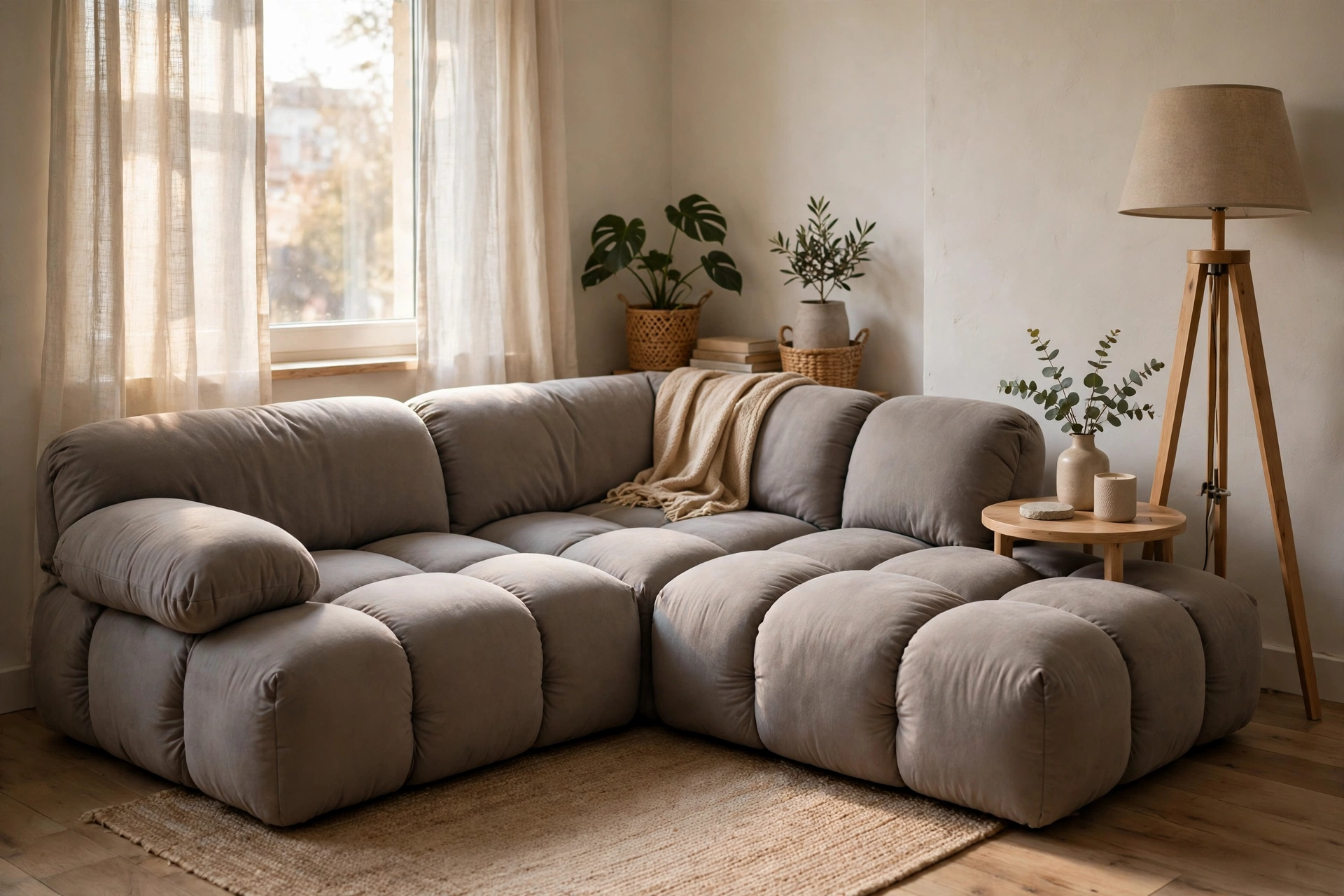
A boneless couch is a sofa with no rigid internal structure at all: the seat, back and arms are formed entirely from blocks of high-density foam. Most are compressed and vacuum-packed for shipping, then allowed to expand once unboxed. Most designs are also modular — individual seat units, corner pieces and ottomans that you rearrange into an L-shape, a U-shaped lounge pit, a straight sofa, or even a flat guest bed.
The look is deliberately soft and informal: deep seats, low backs and rounded, slumped silhouettes that read more like a landscape than a piece of furniture. It is the opposite of the tailored, upright sofa your grandparents polished. If you have seen living rooms styled around sinking-in comfort and movie-night sprawl, you have seen this trend at work.


Why has the boneless couch become so popular?
It became popular because it removes several frictions of ordinary sofa buying at once, while matching a broader shift toward softer interiors. Renters love that there is no heavy frame to haul up stairs and no legs to scratch floors. Small-space households love the modularity: start with two seats, add a corner next payday. Parents and pet owners love that there are no hard edges and, on many models, fully removable washable covers.
The shipping model matters too. A sofa that arrives in boxes at your door, rather than on a truck with a two-person delivery crew, removes one of the biggest obstacles in furniture buying — especially in walk-up apartments. And aesthetically, interior styles have been moving toward softer, more tactile, more relaxed rooms, a shift you can see across several of the looks in our guide to interior design examples and the styles behind them. The boneless couch is simply that mood turned into a product category.
What should you check before you buy one?
Check four things, in this order: the foam, the covers, the true dimensions of the modules, and the seller’s return window. Get those right and most boneless couches will serve you well; get the foam wrong and nothing else can save the purchase. Work through the checks below before you order.
Step by step: the pre-purchase check
- Measure your room and mark the sofa’s footprint on the floor with tape, including its full depth.
- Sketch your intended configuration and count the modules you actually need — no more.
- Ask the seller for the foam density and whether the seat is layered foam rather than a single soft block.
- Confirm the covers unzip fully, are machine washable, and can be bought separately as replacements.
- Check the stated seat height against the needs of everyone who will use it daily.
- Verify that the return window comfortably covers the 48–72 hours the foam needs to fully expand.
Foam density and layers
Ask what the foam density is and whether the seat uses layered foam — a firmer base with a softer top — rather than a single soft block. Sellers who know their product will state this plainly. Vague descriptions like “high-quality sponge” are a warning sign, because with no frame, the foam is the entire structure.
Covers you can actually wash
Confirm the covers unzip fully and are machine washable, and check whether replacement covers are sold separately. On a fabric sofa with no frame to protect it, the cover is your main line of defence against spills and pet hair. When comparing modular sofa systems at large retailers such as IKEA, use the same cover test: if the cover system is complicated, you will wash it less, and the sofa will show it.
Module sizes and total footprint
Measure twice, because modular systems grow easily on paper. Check the depth especially: boneless seats are often far deeper than standard sofas and can overwhelm a small room. If you want to be sure before ordering, lay the configuration out in a free 3D room planner such as Sketch3D-Art Studio Pro and walk around it virtually — a deep lounge pit that looks generous in a listing can eat a small living room.
Boneless vs framed sofa: how do they compare?
The honest answer is that they solve different problems, and the table below shows where each one wins. Neither is universally better — the right choice depends on your household, your floor plan and how you actually sit.
| Factor | Boneless couch | Framed sofa |
|---|---|---|
| Structure | Foam blocks only; no frame or legs | Wooden or metal frame with springs or webbing |
| Delivery | Compressed in boxes; easy up stairs | Usually a scheduled two-person delivery |
| Flexibility | Modules rearrange freely; can form a guest bed | Fixed shape once bought |
| Seat height | Very low; harder for older users to rise from | Standard height; easier to get up from |
| Support over time | Depends entirely on foam quality; cannot be re-sprung | Frame and springs can often be repaired |
| Look | Soft, slumped, informal | Tailored and structured |
| Maintenance | Regular plumping; covers often washable | Less frequent cushion care |
What is it like to live with one, day to day?
Day-to-day life with a boneless couch revolves around one small ritual: plumping. Without a frame to hold its shape, a foam sofa needs its cushions shaken out and rotated regularly — weekly is realistic — to keep the silhouette even and slow down permanent compression where people always sit. Build it into your routine and the sofa keeps its shape far longer.
Modules should also be lifted and aired occasionally in humid homes, since solid foam breathes less than sprung upholstery. None of this is difficult, but it is maintenance a framed sofa simply does not ask of you — and it is worth knowing before you buy rather than discovering it in month three.
Who should buy one — and who should skip it?
Buy one if your living room is primarily a place to sprawl: it is close to ideal for renters, first apartments, media rooms and playrooms. It also works well as a flexible second sofa in an open-plan space, where modules can be pulled apart for guests and pushed together for weekends.
Skip it if your household needs height and firm support. The very low seat can be genuinely difficult for older people or anyone with knee or back trouble, and deep, soft seats encourage slouching — fine for films, less fine for reading or working for hours. It is also a poor fit as the only formal seating in a home that hosts older relatives often. Being honest about which household you are matters more than the trend.

Common mistakes
Buying on the photo, not the foam. Every boneless couch looks inviting when new. The difference between a five-year sofa and a one-year disappointment is foam density, which no photograph shows.
Under-measuring the depth. Boneless seats are much deeper than standard sofas. Skip the tape-measure step and the “compact” modular set can swallow a small room.
Judging it before it has expanded. Compressed foam needs 48 to 72 hours to reach full shape and lose its packaging smell. Decide after that window, not on day one.
Ignoring the return window. If the returns period ends before the foam has fully expanded, you are judging — and keeping — a half-finished product.
Forgetting the plumping routine. Foam that is never rotated compresses permanently where people always sit. A minute a week prevents the lopsided look owners complain about.
Frequently asked questions
How long does a boneless couch last?
It depends almost entirely on foam quality, because the foam is the whole structure. Higher-density, layered foam holds its shape for years; cheap single-block foam can soften and sag within a year or two, and it cannot be repaired.
Is a boneless couch good for your back?
For short, relaxed sitting it is comfortable, but the deep, soft seat encourages slouching over long periods. If you read or work on the sofa for hours, or have back trouble, a firmer framed sofa is usually the safer choice.
Can a boneless couch work as a guest bed?
Yes — that is one of the format’s genuine advantages. Most modular systems rearrange into a flat sleeping surface, which makes them practical for small homes that host guests occasionally.
How long does the foam take to expand after unboxing?
Typically 48 to 72 hours to reach full shape. A packaging smell is common at first and fades as the foam airs, which is why your return window should cover this period comfortably.
Are boneless couches good with kids and pets?
Generally yes: there are no hard edges or legs, and many models have fully removable, machine-washable covers. Confirm the covers unzip completely before buying, because that feature does the heavy lifting.
Conclusion
The boneless couch earned its search numbers honestly: it is flexible, renter-friendly, comfortable and easy to buy. It is also unforgiving of cheap foam and wrong for households that need height and firm support. Your next step is simple — run the six-step check above on any model you are considering, and lay the configuration out in 3D with a tool like Sketch3D-Art Studio Pro before money changes hands.
Have you tried a boneless or modular sofa at home — did the comfort win, or did you miss the structure of a framed couch?





 English
 العربية
 Français