

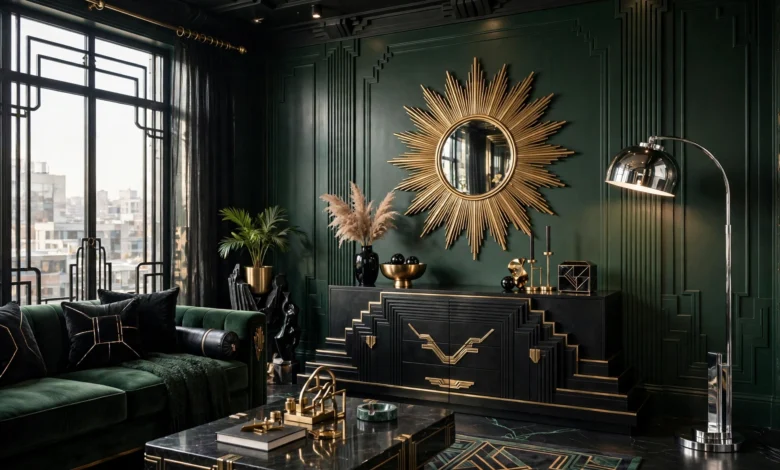
A neo deco interior takes the geometry of 1920s Art Deco — sunbursts, chevrons, stepped profiles, bold symmetry — and rebuilds it with today’s materials, restraint and a flash of chrome. Neo Deco is a named trend prediction in Pinterest’s 2026 outlook, and Homestyler’s signals show saves for chrome and dark-metal decor surging, which tells you the look is moving from mood boards into real rooms. This guide teaches you the geometry, the metal palette and the room-by-room method to apply neo deco interior style with confidence — and without tipping into kitsch.
Key takeaways
- Neo deco keeps Deco’s geometry — sunbursts, chevrons, stepped forms, symmetry — but edits it with modern restraint.
- Chrome and dark metals are the signature accents; use them as highlights, not wall-to-wall finishes.
- Work in a formula per room: one geometric statement, one metal accent group, one luxurious texture.
- Deep colours (ink, emerald, oxblood) or warm neutrals both work — what matters is contrast against the metal.
- Kitsch is avoided by subtraction: fewer motifs, larger scale, better materials.
What is a neo deco interior?
A neo deco interior is a contemporary revival of Art Deco that keeps the movement’s architectural geometry while dropping its period costume. Original Deco filled rooms with ornament; neo deco selects. You might see a single sunburst mirror over a plain plaster wall, a stepped-profile sideboard in dark wood, and chrome lighting — nothing more, and nothing needed.
The style’s timing is no accident. Pinterest named Neo Deco among its 2026 trend predictions, and Homestyler’s platform signals show chrome and dark-metal decor being saved at surging rates. After a decade of soft minimalism, people are hungry for rooms with rhythm, shine and a sense of occasion. Neo deco delivers that drama in controlled doses, which is exactly why it suits ordinary homes rather than only hotels and film sets.

Which geometric motifs define neo deco?
Three motifs do most of the work: the sunburst, the chevron and the stepped form. Sunbursts radiate from a centre point and belong on mirrors, clock faces, headboards and cabinet inlay. Chevrons — repeating V shapes — suit floors, tiles, rugs and upholstery. Stepped forms, borrowed from Deco-era skyscrapers, appear in sideboard profiles, shelving, fireplace surrounds and lighting tiers.
How to combine motifs without chaos
Assign each room one lead motif and let the others appear, at most, as quiet echoes. A chevron floor can carry a room alone; add a small stepped lamp profile and stop. Symmetry is your stabiliser: Deco geometry reads as intentional when it is balanced around a centre line, and as random when it is not. When in doubt, mirror the arrangement — pairs of chairs, paired sconces, a centred rug — before adding any new pattern.
| Motif | Where it works best | Scale guidance | Pairs well with |
|---|---|---|---|
| Sunburst | Mirrors, headboards, cabinet fronts, ceiling roses | One large statement per room | Plain walls, dark paint, chrome frames |
| Chevron | Flooring, tiles, rugs, upholstery | Medium repeat; larger in big rooms | Stepped profiles, smooth velvet |
| Stepped form | Sideboards, shelving, fireplaces, tiered lighting | Architectural scale — built-ins and furniture | Sunburst accents, black metal |
| Fan / scallop | Tile layouts, chair backs, wallpaper | Small-to-medium repeat, one surface only | Brass or chrome grout lines and trims |
| Bold symmetry | Whole-room layouts, mantel styling, bed walls | Room scale — the organising principle | Every other motif; it is the stabiliser |

How do chrome and dark metals fit the neo deco palette?
Chrome and dark metals fit as the jewellery of the room: bright chrome for Deco-authentic shine, blackened or gunmetal finishes for the 2026 edge. Homestyler’s save data shows both surging, and they divide the labour well — chrome reflects light and lifts deep colours, while dark metal grounds pale schemes and adds the graphic outline Deco geometry needs.
Apply metals by the handful, not the bucket. Choose lighting first, since fixtures are the most visible metal in any room, then echo the finish in two smaller places: a table frame, mirror edge, handles or a tray. If you want to study how quality metal furniture is built and finished before you buy, our roundup of the top metal furniture brands for durable designs is a solid primer.
The per-room formula
- Choose the room’s lead motif — sunburst, chevron or stepped.
- Place one statement piece carrying that motif.
- Add a metal accent group: one large fixture plus two small echoes.
- Lay in one luxurious texture — velvet, marble, lacquer or dark wood.
- Remove any item that introduces a second competing motif.
How do you apply neo deco room by room?
You apply it by repeating the formula while changing the lead motif, so each room feels related but not identical. Keep the metal family consistent across the home — all chrome and black, say — and let colour deepen or lighten by room. For broader context on how revival styles are trending this year, see our analysis of interior design examples and why these styles trend.
Living room
Lead with a stepped sideboard or a sunburst mirror, flanked symmetrically by chrome sconces or table lamps. A velvet sofa in ink, emerald or oxblood supplies the luxurious texture, and a chevron rug — or none, if the floor already speaks — finishes the geometry. Keep cushions plain; the room already has enough pattern.
Bedroom
Use a fan or sunburst headboard as the single statement, with paired dark-metal bedside lamps for symmetry. Bedding stays smooth and deep-toned, and a lacquered or dark-wood dresser echoes the stepped profile quietly. The effect should feel like a boutique hotel: dramatic at the headboard wall, calm everywhere else.
Bathroom and hallway
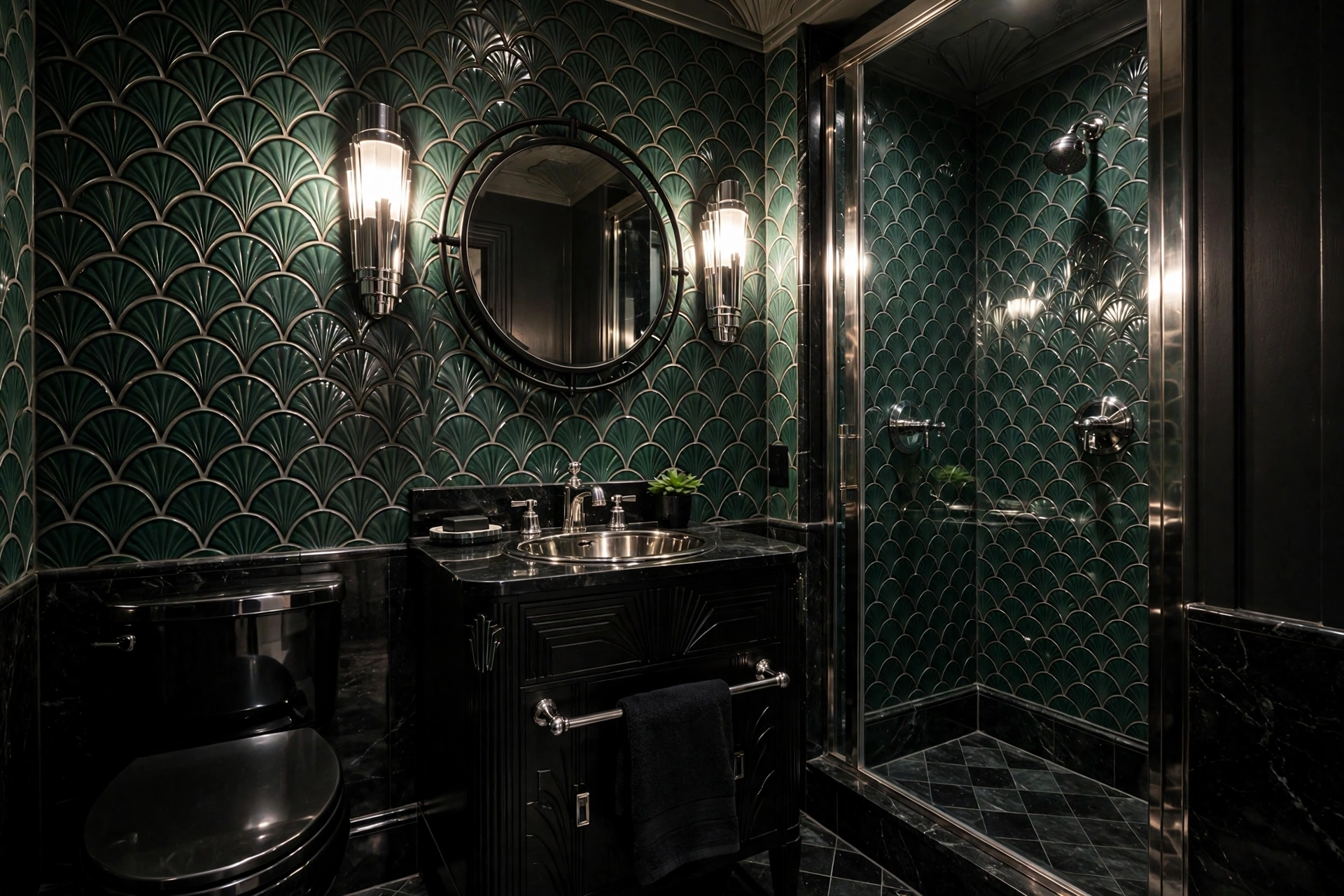
Small rooms take neo deco brilliantly because one surface can carry the whole scheme. Scallop or chevron tiles with chrome fittings transform a bathroom; in a hallway, a sunburst mirror, a stepped console and a dark-metal pendant create a full Deco moment in two square metres. These compact applications are also the cheapest way to test the style before committing a main room.
Should you choose deep tones or warm neutrals?
Choose deep tones if you want the full evening glamour of the style, and warm neutrals if you want neo deco that works in daylight family life. Ink, emerald and oxblood walls or upholstery make chrome sparkle and turn a living room into an occasion; the cost is that deep schemes demand confident lighting, because a dim deep-toned room reads as heavy rather than rich. Add layered light — pendants, sconces and table lamps on separate switches — before you commit to the darkest paint.
The neutral route uses plaster, warm white and pale stone as the ground, then lets geometry and metal do the talking: a black stepped sideboard, a chrome sunburst mirror, chevron cushions in charcoal and cream. This version suits north-facing rooms and open-plan spaces where one deep wall would unbalance the whole floor. Many homes mix the two — neutral main rooms, one deep, jewel-toned bedroom or study — and the shared metal family keeps the story coherent. Whichever direction you choose, test the colour against your actual chrome pieces, because metal shifts from mirror-bright to grey depending on the wall behind it.
Where do you find neo deco inspiration and pieces?
Start with the trend’s source: browsing Neo Deco boards on Pinterest shows you the motifs at every budget and scale, and saving what you love reveals your personal lead motif within a week. Then translate one board into one room using the formula above, rather than copying a whole image.
Shop in layers. Invest in the statement piece and the lighting, where material quality shows; save on the echoes — trays, handles, cushion trims — where small chrome or dark-metal touches cost little. Vintage and reproduction Deco pieces mix happily with modern ones, because the geometry, not the age, carries the style.
Common mistakes
The first mistake is motif pile-up: sunburst mirror, chevron floor, scallop chairs and stepped shelves in one room reads as a theme restaurant, not a home. One lead motif per room is the discipline that keeps neo deco elegant.
Second, costume colours. Gold everything, black everything, or the teal-and-gold combination applied without variation turns a revival into fancy dress. Neo deco in 2026 uses chrome as much as brass, and warm neutrals as often as jewel tones. Third, shiny clutter: chrome shows every fingerprint and competes with itself, so five reflective objects in one sightline create visual noise instead of glamour.
Finally, forgetting comfort. Deco geometry is hard-edged by nature; if you skip the velvet, the rug and the upholstered seat, the room photographs beautifully and lives badly.
Frequently asked questions
Is neo deco the same as Art Deco?
No. Art Deco is the original 1920s–30s movement, rich with ornament and period detail. Neo deco is its 2026 revival: the same geometry and symmetry, edited down, mixed with modern materials and everyday furniture.
Which colours suit a neo deco interior?
Deep tones — ink blue, emerald, oxblood, charcoal — make chrome glow, while warm neutrals and plaster tones give a softer, more contemporary version. Either direction works if the contrast against your metal accents stays strong.
Can neo deco work in a small flat?
Yes, arguably better than in large rooms, because one motif carries a small space completely. Use the bathroom or hallway method: a single patterned surface, one mirror or statement piece, and consistent metal finishes.
Chrome or brass — which is more neo deco in 2026?
Chrome is the fresher signal this year, matching the surge in chrome and dark-metal saves, and it is historically true to Deco’s machine-age shine. Brass still works in warmer schemes; just do not mix both metals at equal strength in one room.
How do I start without redecorating everything?
Follow the formula in one room: add one geometric statement (a sunburst mirror is the classic first buy), one chrome fixture, and one velvet or lacquer texture. Live with it for a month, then extend the same metal family to the next room.
Keep learning: revival styles reward a light hand — compare this edited approach with the layered warmth of our afrohemian decor guide to see how two 2026 styles handle pattern in opposite ways.
Conclusion
You now have the neo deco method: choose one lead motif per room, stabilise it with symmetry, add chrome or dark metal as jewellery, and soften the geometry with one luxurious texture. That discipline is what separates a 2026 neo deco interior from a Deco costume party. Start with a hallway or bathroom, photograph the result, and let the formula travel through your home. Which motif will lead your first room — sunburst, chevron or the stepped profile?


 English
 العربية
 Français