

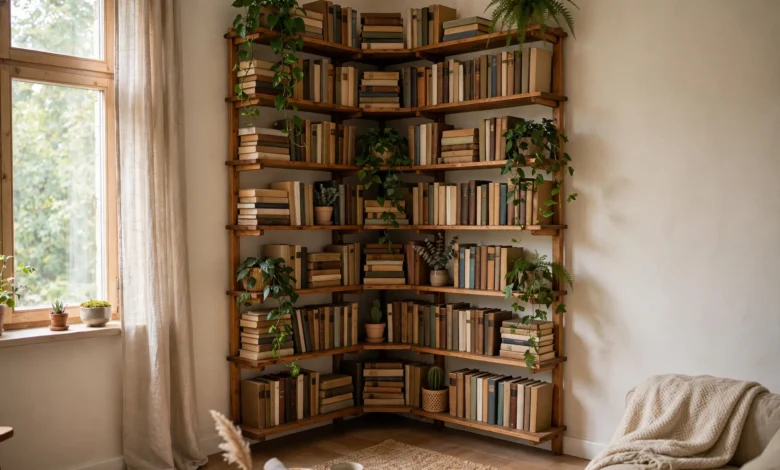
A corner book shelf works when it is measured to the real corner — few corners are perfectly square — sized to the books you actually own, and anchored so a loaded tower cannot tip. Get those three things right and the deadest square metre in your apartment becomes its hardest-working storage.
Interest in the idea is climbing fast: “corner book shelf” draws about 49,500 searches a month, up 22% year over year according to Rising Trends data from October 2026. This guide teaches you the full process: measuring a corner honestly, choosing between ladder, tower and wrap-around styles, anchoring safely, and styling the result so it looks designed rather than dumped.
Key takeaways
- Measure both walls, the ceiling height and the corner’s squareness before you shop — corners lie.
- Baseboards, outlets and radiators decide the real footprint, not the catalogue dimensions.
- Ladder shelves lean and lighten; tower shelves maximise capacity; wrap-around shelves use both walls fully.
- Every tall corner unit must be anchored to the wall — a loaded bookshelf is top-heavy by nature.
- Style with breathing room: heavy books low, space left empty, and one object among the books.
How do you measure a corner for a corner book shelf?
Measure the corner itself, not the room: run your tape along both walls from the corner outwards, record the floor-to-ceiling height, and check whether the corner is square by measuring how a large, known-square object — a big book or a board — sits against both walls. Walls bow, corners drift, and a rigid unit built for a perfect 90 degrees will rock or gap in a corner that is really 88.

Measure in this order:
- Measure the height from floor to ceiling, and note anything that intrudes — coving, beams, sloped ceilings.
- Measure out along the left wall to the first obstruction: door frame, window, radiator or socket.
- Measure out along the right wall the same way; the shorter of the two runs often decides your design.
- Measure your baseboards’ height and depth — the unit must clear them, span them, or be notched around them.
- Check squareness with a large square object against both walls, and note which way the corner leans.
- Measure your tallest and deepest books; shelf spacing and depth come from the books, not from the furniture.
If the corner is noticeably out of square, prefer styles that forgive it: a freestanding ladder shelf touches the wall at a line, not across a surface, and floating wrap-around shelves can be scribed or spaced to fit. Save the precise built-in look for corners that measure honestly — or for a carpenter who will fit to the wall rather than to the drawing.
Before you start: what you need
Gather the tools and facts before money changes hands. You need a tape measure, a spirit level, and a stud finder if you will anchor into plasterboard walls. You need the measurements from the routine above, plus a decision about what actually lives on the shelf — paperbacks, art books, plants, a speaker — because each argues for different shelf depths and spacing.
Finally, decide your fixing honestly. Anchoring into a stud or masonry is a different commitment from anchoring into hollow plasterboard, and the right hardware differs completely. Know your wall type before the unit arrives, not while it leans against it.
Which style fits your corner?
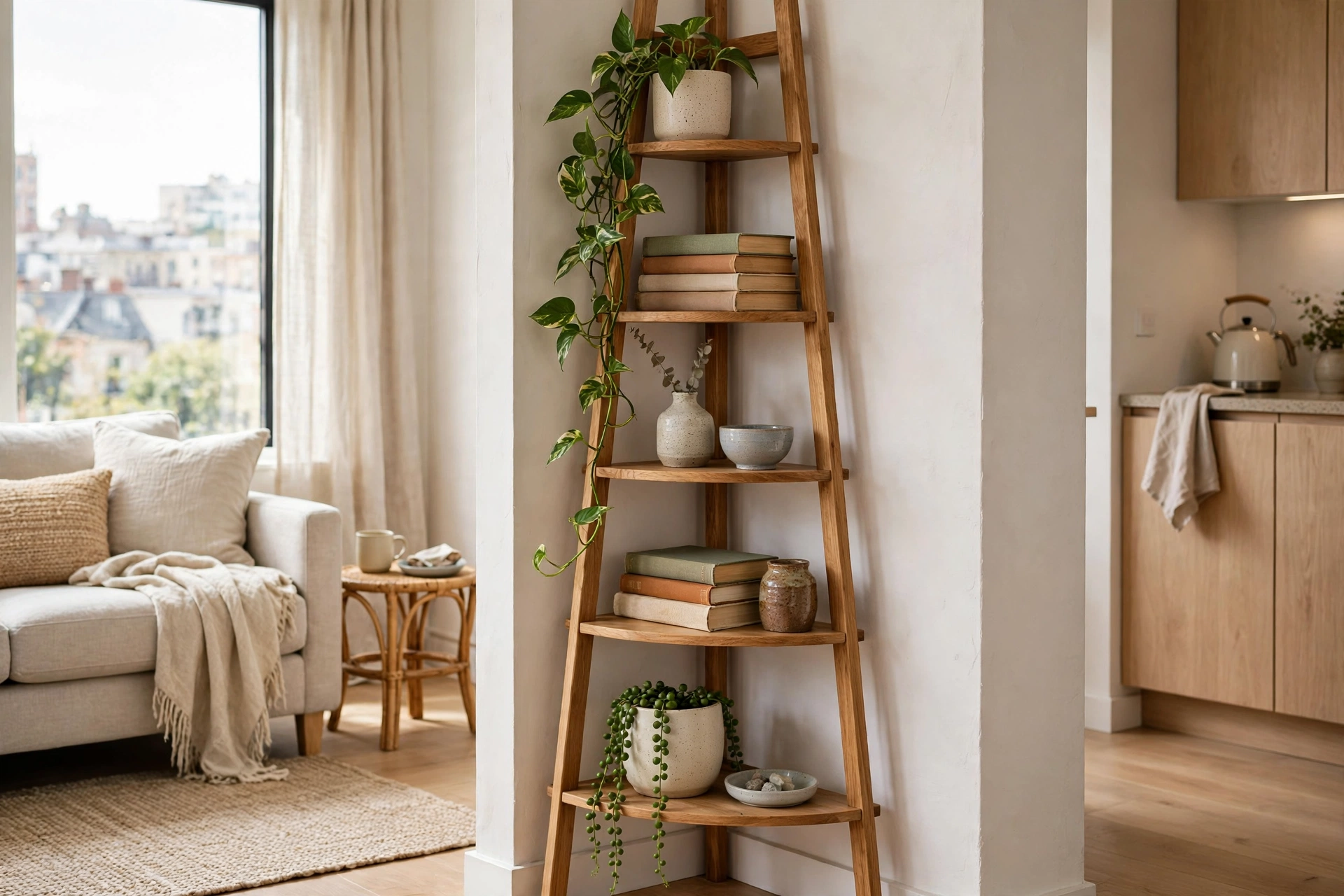
Ladder shelves
The ladder shelf leans against the wall, narrow at the top and deeper at the base, with shelves like rungs. It is the friendliest style for renters and small rooms: it arrives flat, assembles quickly, touches the wall lightly and reads as furniture rather than construction. Capacity is modest and the leaning profile wastes a little depth, but for paperbacks, plants and objects it is often all a corner needs.
Tower shelves
A tower — sometimes a rotating or quarter-round “pie” tower — stands vertically in the corner with a small footprint and shelves stacked high. Nothing beats it for books per square metre of floor. The trade-offs are presence and safety: a tall, loaded tower is a monolith in the room and absolutely must be anchored, because its height and narrow base make it the most tip-prone style here.
Wrap-around shelves
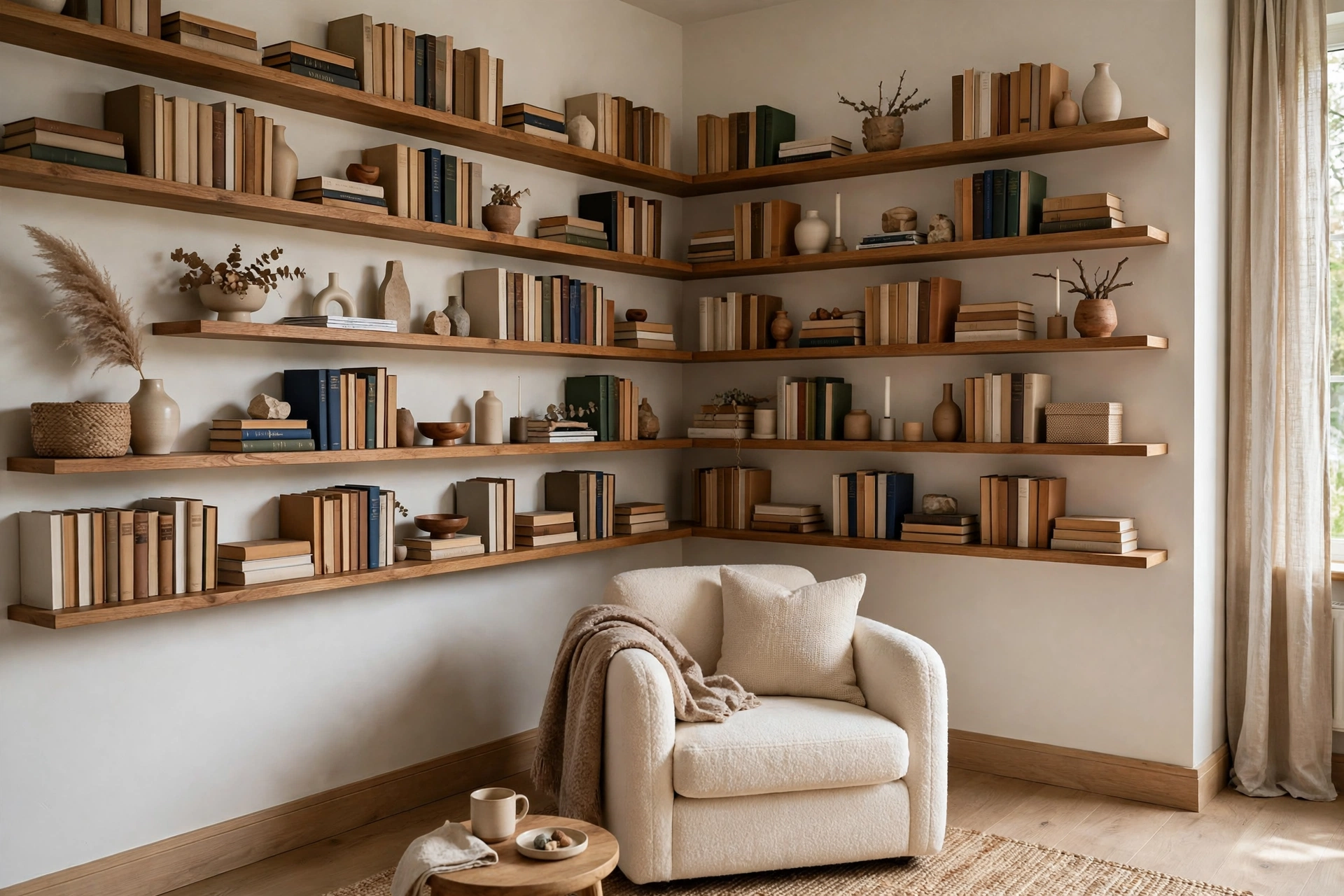
Wrap-around designs put floating or bracketed shelves on both walls, meeting in the corner so the shelving turns the turn. They use the corner most completely, keep the floor clear — a real gift in small apartments — and can be cut to fit awkward walls. They are also the most installation-heavy option, and every shelf’s fixing must find solid structure, because books are heavy and floating shelves forgive nothing.
| Style | Footprint | Capacity | Best for | Watch out for |
|---|---|---|---|---|
| Ladder | Small; leans on one wall | Modest | Renters, light collections, plants and objects | Limited depth on upper shelves |
| Tower | Smallest floor area | Highest per square metre | Serious book collections in tiny rooms | Must be anchored; visually dominant |
| Wrap-around | No floor footprint | High; uses both walls | Permanent homes, awkward corners, clear floors | Installation effort; fixings must hit structure |
| Corner bookcase unit | Moderate; shaped to the corner | High | A finished, furniture look with doors or drawers | Least forgiving of out-of-square corners |
How much weight can corner shelves hold — and how do you anchor them safely?
A shelf holds what its fixings hold: the same board is rock-solid screwed into studs or masonry and a liability hanging on plasterboard alone. Books are deceptively heavy — a single metre of hardbacks can outweigh a small child — so treat capacity as a fixing question first and a furniture question second. When a manufacturer gives a per-shelf limit, respect the lower of that limit and what your wall hardware can honestly carry.
Anchor tall units without exception. Run the fixing strap or bracket from the top of the unit into a stud or solid wall, not into plasterboard alone, and do it before loading a single book. Load heavy books on the lowest shelves, which lowers the centre of gravity and makes the whole unit calmer. Keep the top shelves for light objects — they are the worst place for weight and the best place for a plant.
Work through the safety sequence:
- Locate the studs or confirm the masonry where the anchor will land.
- Level the unit and mark the anchor point at the top rear.
- Fix the anti-tip strap or bracket to the wall with hardware matched to the wall type.
- Attach the unit to the strap so it cannot pull away from the wall.
- Load from the bottom up, heaviest books lowest, and re-check level once loaded.
Styling rules that keep it looking designed
The difference between a styled shelf and a storage accident is editing, and the rules are simple enough to apply in an afternoon. They are the same principles stylists use across a whole room — our tour of interior design examples and the styles behind them shows how consistently they recur — applied here at shelf scale.
- Work in thirds. Fill roughly two-thirds of a shelf and leave the rest as air; unbroken rows of spines are what make shelves look like warehousing.
- Alternate orientation. Break vertical rows with one or two horizontal stacks, which double as bookends and as plinths for a small object.
- Put weight low, lightness high. Big books ground the unit visually as well as physically; the top shelf takes the plant, the print, the small lamp.
- Repeat a colour or material. Echo the shelf’s timber in a frame or the finish of the room’s metal furniture in a bookend, and the corner joins the room instead of interrupting it.
- Shop before you shelve. If the look still is not right, browse how complete pieces handle the same corner — ranges like those at IKEA are useful reference even when you build or buy elsewhere.
Common mistakes
Assuming the corner is square. It usually is not. A rigid unit in a drifting corner rocks, gaps, or forces fixings into bad positions. Measure squareness first and choose a forgiving style when the corner lies.
Forgetting the baseboards. A unit that stands 15 mm off the wall on its baseboard leans backwards, strains its anchor and looks wrong forever. Clear them, bridge them, or notch for them — decide before delivery day.
Skipping the anti-tip anchor. The single most dangerous mistake on this page. Tall, loaded shelving tips, especially with children or in earth-quiver regions, and “it feels steady” is not a test. Anchor it.
Loading the top shelves with the heavy sets. Encyclopaedias at head height raise the centre of gravity and the consequences of any failure. Heavy goes low; light goes high. No exceptions for symmetry.
Buying before measuring the books. Standard shelf spacing swallows paperbacks and rejects the art books that were the point. Measure your tallest and deepest books first and let them set the dimensions.
Frequently asked questions
How deep should corner shelves be?
Deep enough for your largest books with a small margin: most novels and paperbacks sit happily in around 20 cm of depth, while large art and photography books can need 30 cm or more. Measure your biggest book and add a centimetre or two. Deeper than that wastes the corner and invites clutter to hide at the back.
Can I use a corner bookshelf in a rented apartment?
Yes — choose a ladder or freestanding tower style, which needs at most a small anti-tip fixing rather than a wall of brackets. Even in a rental, do not skip the anchor on a tall unit; a single discreet screw hole is a small price against a toppled bookcase. If fixings are truly forbidden, keep the unit low and wide rather than tall.
Do floating wrap-around shelves really hold books?
They do when the brackets are rated for the load and fixed into studs or masonry at the spacings the maker specifies. They fail when fixed into plasterboard alone or spaced too far apart for the shelf board. Books concentrate serious weight in a small area, so treat the fixing specification as part of the design, not an installation detail.
What height should a corner shelf be under a window?
Keep the top of the unit at or just below the sill line so the window keeps its light and the shelf reads as intentional rather than crowding the glass. That usually means a low bookcase or a ladder shelf stopped at the right rung. Measure to the underside of the sill, not to the frame’s outer edge.
How do I stop a corner shelf looking cluttered?
Edit before you arrange: remove a third of what you planned to shelve, group books by size or colour family, and leave deliberate gaps. One object — a plant, a framed print, a small lamp — earns its place per few shelves; more than that competes. Clutter is a quantity problem disguised as an arrangement problem.
Keep learning: corners are only one small-space opportunity — built-in bench seating hides even more storage, as our guide to banquette seating for dining nooks shows.
Conclusion
A corner shelf succeeds on unglamorous virtues: honest measurements, a style matched to the corner and the collection, fixings that respect the weight of books, and an anchor at the top. Then, and only then, does styling get its turn — and the styling is mostly restraint. Follow that order and the corner everyone ignores becomes the part of the room guests ask about.
Your next step is the measuring routine: six measurements, one cardboard template if the corner looks doubtful, and a decision about your wall type. An hour with a tape measure is what separates a shelf that fits from a return label.
What is living in your most neglected corner right now — and what would you shelve there first?



 English
 العربية
 Français