


The tabletop was flat the day you glued it up. Three weeks later it rocks on the bench, a mitre has opened like a smile, and one board has cupped enough to hold water. Nothing about your joinery failed — the wood simply kept drying after you built with it, and it moved the way drying wood always moves. So the real question is the one every disappointed builder ends up asking: how long to acclimate lumber before it is safe to build with? This article gives you the honest answer — why the calendar alone cannot tell you, the rough timelines worth starting from, and the simple meter test that tells you when a board is actually ready.
اهم النقاط باختصار
- There is no universal number of days: acclimation ends when the wood reaches equilibrium with the room it will live in, not when a week passes.
- The true test is a moisture meter: readings that stay stable on consecutive days mean the board has settled.
- Kiln-dried lumber still needs shop acclimation — usually days to a couple of weeks — because your shop is not the kiln, and neither is the lumberyard.
- Furniture for heated interiors generally settles around 6–9% moisture content; unconditioned workshops sit nearer 10–14% (approximate ranges).
- Mill in two stages — rough-mill oversize, rest, then final-mill — so the movement happens before the joinery, not after it.
How long to acclimate lumber, really?
Long enough for the wood to reach equilibrium moisture content (EMC) with its destination — and not one day is wasted beyond that. Wood is hygroscopic: it absorbs and releases water vapour until its internal moisture matches the surrounding air. A board that arrives wetter than your room will keep shrinking inside your finished piece; a board that arrives drier will swell. Acclimation is simply giving that exchange time to finish قبل the wood becomes furniture.

That is why any flat answer like “one week” misleads. A thin kiln-dried board moved into a similar climate may settle in a few days. A thick, air-dried slab from a damp barn may need months. What you are waiting for is not a date but a condition: moisture content close to the EMC of the room the furniture will live in, and stable. As a rough orientation, furniture destined for heated interiors usually ends up around 6–9% moisture content, while wood living in unconditioned workshops and outbuildings sits nearer 10–14% — approximate ranges that shift with climate and season.
Why does wet lumber destroy finished furniture?
Because wood does not shrink evenly, and it does not ask permission. As a board dries below the fibre saturation point, it shrinks across the grain — tangentially roughly twice as much as radially, and almost not at all along its length. In a stack of rough boards, that shrinkage is harmless. Inside a glued-up panel, a framed door or a mitred box, it becomes force: panels cup, joints are levered open, wide boards split rather than stretch, and drawers that slid sweetly in the shop jam by winter.
The damage is worst when the moisture is uneven — a dry shell around a wet core, or one face drying faster than the other. That gradient is exactly what fresh, un-acclimated lumber carries. If you want the full mechanics of how moisture gradients bend boards, our guide to التواء الخشب بعد التصنيع walks through cup, bow, crook and twist one by one. Acclimation is how you drain the gradient away before it can do any of that inside your project.

How long does acclimation take for different boards?
Use the table below as a starting estimate only. Every figure is a rough rule of thumb: species, starting moisture, board thickness, airflow and your shop’s humidity can halve or double any of them. The traditional air-drying rule — about one year per inch of thickness — belongs to drying green wood from scratch, not to settling bought lumber, but it explains why thick stock is always the slow case.
| Board and starting point | Rough acclimation guide | What decides it |
|---|---|---|
| Kiln-dried 4/4 (25 mm) from the lumberyard | A few days to about two weeks in your shop | How different your shop’s humidity is from the yard’s storage |
| Kiln-dried 8/4 (50 mm) | One to three weeks, sometimes longer | Thickness: the core lags far behind the shell |
| Air-dried 4/4, stored outdoors or in a barn | Several weeks to a few months indoors | Starting moisture and the season it was dried through |
| Green or freshly sawn 4/4 | Months; the traditional rule says roughly a year per inch to air-dry | Species and airflow — this is drying, not just settling |
| Green or air-dried 8/4 | Many months to around two years by the per-inch rule | Thickness dominates everything else |
| Any board moved to a new climate or a heated room | Days to a few weeks to re-settle | The size of the climate jump, not the board’s history |
Read the table as a planning aid, then let the meter overrule it. A board that hits the target range and holds it for consecutive days is ready early; a board still drifting after a month is not ready, whatever the calendar says.
How do you acclimate lumber step by step?
Acclimation is a routine, not a waiting room. Work through it in this order:
- Measure on arrival. Before the boards leave your bench the first time, take moisture readings — several boards, several spots. Note the numbers and the date; this is your baseline, and it tells you whether you bought nearly-ready wood or a long project.
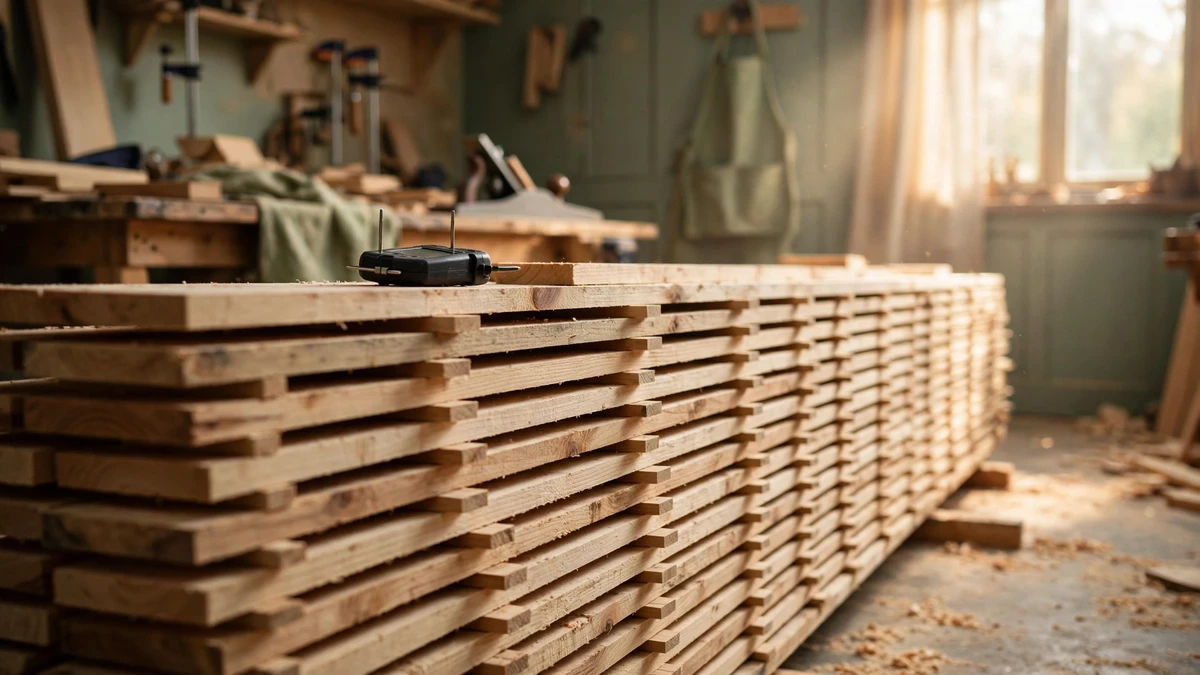
- Sticker-stack correctly. Stack the boards flat on a level base, with dry stickers (thin, uniform strips of wood) between every layer, aligned vertically so the weight transfers straight down. Keep stickers near the ends to support the board tips, where drying is fastest.
- Give the stack air. Air must reach every face. Leave gaps around the stack, keep it off a cold or damp floor, and never wrap green or damp boards in plastic — that traps moisture and grows mould instead of equilibrium.
- Wait — in the right room. Ideally the stack waits in conditions close to where the furniture will live. A heated room’s future sideboard acclimates best in heated-room air, not in a damp garage.
- Verify with a meter, in the core. Surface readings flatter you. Push pin probes into the end grain or a freshly cut face to sample deeper wood, and weigh the reading against your room’s expected range (roughly 6–9% for heated interiors). Two or three stable readings on consecutive days mean the board has settled.
- Rough-mill oversize. Joint, plane and rip to rough dimensions, leaving everything a few millimetres fat. Milling exposes fresh, often wetter interior wood and releases internal stresses — the board will move again, and you want that movement to happen now.
- Rest again. Re-stack the rough parts with stickers for a few more days. This second, shorter rest is the step most builders skip and the one that saves the most tabletops.
- Final-mill to dimension. Only now take parts to exact thickness and width, removing material evenly from both faces where you can, so the moisture balance you achieved is not destroyed at the last moment.
- Finish both faces. Seal every face — including the underside nobody sees — with the same finish schedule. Uneven finishing creates an uneven moisture exchange, and the board cups toward the drier side. Our explainer on why tabletops cup and how to stop it shows how often this single habit is the culprit.
Should lumber acclimate in the shop or in the house?
In whichever conditions the finished piece will live — or the closest match you have. A board settled to a damp workshop’s equilibrium will start moving again the week it moves into a dry, heated flat. If your shop is unconditioned and the furniture is bound for a heated interior, give the parts a final rest in the house itself (or a similarly heated room) before final milling and assembly. It feels fussy; it is cheaper than a returned commission.
What happens if you skip acclimation?
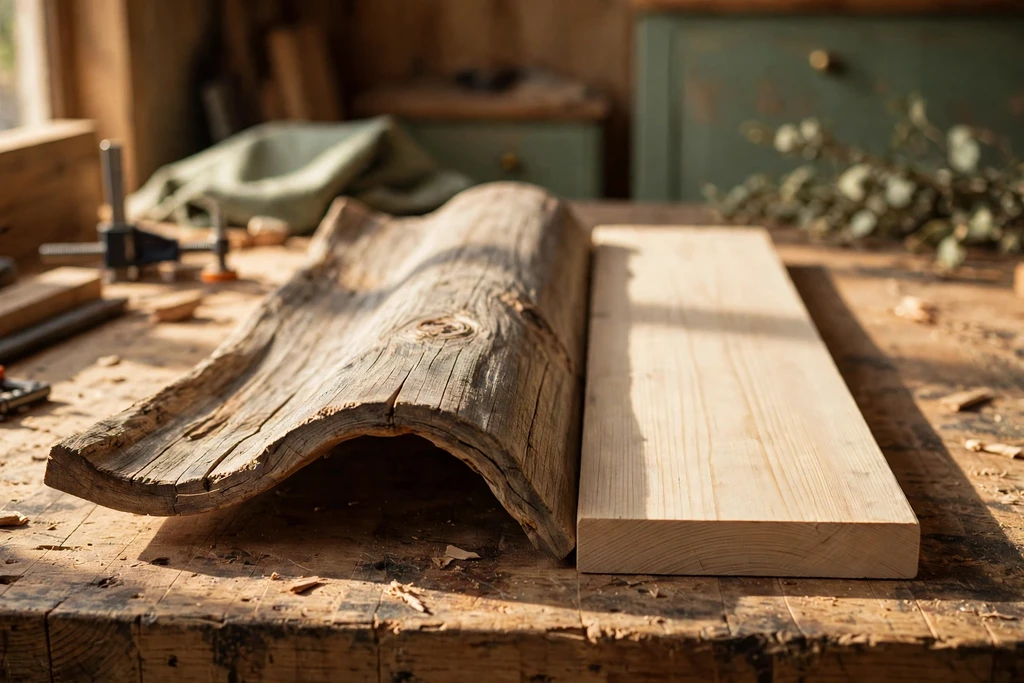
You do not skip the movement — you schedule it for after the glue-up. The panel that was flat in October cups by December. The mitres you shot perfectly open at the corners as the rails shrink across their width. Tabletops split along the glue line or tear their fixings loose, because a wide board shrinking across the grain pulls with enormous force and something has to give. None of this is bad luck or bad craftsmanship; it is a drying schedule finishing itself inside your furniture. Every one of these failures is the same sentence: the wood was still travelling when you built with it.
Common mistakes when acclimating lumber
- Counting days instead of measuring moisture. “It sat for two weeks” says nothing. Two boards of different thickness and history need different times; the meter, not the calendar, gives the verdict.
- Trusting the surface reading. A dry shell over a wet core is the normal state of a thick board mid-acclimation. Sample the core or the end grain before you declare victory.
- Stacking without stickers, or with misaligned ones. Boards stacked face-to-face trap moisture and stain; stickers that do not line up vertically bend the pile — and the boards in it — into a permanent bow.
- Acclimating in the wrong climate. Settling wood in a damp garage for a heated living room just restarts the clock when the piece moves indoors.
- Milling straight to final size. One-pass milling leaves no allowance for the movement that rough-milling releases. The second rest after rough-milling is where accuracy is born.
- Finishing one face only. The unseen underside still exchanges moisture. Finish it the same way, or the panel cups toward the imbalance.
- Assuming “kiln-dried” means “ready”. Kiln-dried describes how the wood left the kiln, not the state it is in after months in a yard, a truck and your rack. It still needs to settle to your room.
اسئلة شائعة
Can I acclimate lumber faster with a fan or a heater?
A fan, yes — gently. Moving air across the stack evens out drying and shortens the wait, and it is standard practice. Blasting boards with heat, no: forced, rapid surface drying creates exactly the shell-versus-core gradient that causes checking and case hardening, so you finish faster with worse wood.
Does kiln-dried lumber really need acclimation?
Yes — usually days to a couple of weeks. The kiln brought the wood to a target moisture in the kiln’s conditions; storage, transport and your shop have been changing it ever since. Acclimation here is not drying from scratch, just letting the boards settle to the room they will be worked and used in.
What moisture content should furniture wood be?
Match the destination, not a universal number. As approximate ranges, furniture for heated interiors usually settles around 6–9% moisture content, while pieces for unconditioned workshops, garages and outdoor-adjacent spaces sit nearer 10–14%. The USDA Forest Products Laboratory’s Wood Handbook publishes the equilibrium tables behind these ranges if you want the full picture for your climate.
How do I know the core of a thick board is dry enough?
Cut a short offcut from the end and test the freshly exposed face, or use insulated deep-drive pins that read at a set depth. Comparing a surface reading with a core reading on the same board tells you the gradient; when the two nearly agree and stay stable across consecutive days, the board is settled.
My boards were fine in the shop but moved after delivery — why?
Because they acclimated to your shop, not to the customer’s home. A heated, dry interior is a different equilibrium from most workshops, so the wood resumed moving on arrival. The fix for next time is a final rest in destination-like conditions before final milling — and designing joints that tolerate the small movement that always remains.
The bottom line: let the wood finish moving first
Acclimation is the cheapest insurance in woodworking: a flat stack, some stickers, a meter, and patience measured by readings rather than dates. While the stack settles, use the time well — finalise the design, cut lists and joinery on screen in Sketch3D-Art Studio, so that the day the meter says “ready”, every dimension is already decided. Build with wood that has finished moving, and your joints stay closed, your panels stay flat, and the piece you deliver is the piece that survives its first winter.
Sources: Stephen Corbett, «Le Grand Livre du Menuisier» (Éditions Fleurus), chapter «Le bois», for wood behaviour and moisture principles; USDA Forest Products Laboratory, Wood Handbook — Wood as an Engineering Material, for equilibrium moisture content guidance.





 English
 العربية
 Français